Spine and orthopedic care
Dr. Jimenez treats the full range of spine problems — from a first herniated disc to complex reconstruction — across three offices in Georgia.
The approach doesn’t change much depending on how you got here. Whether the pain started with a car accident, a lifting injury, or nothing identifiable at all, the process is the same: work out precisely what’s causing it, then start with the least invasive thing likely to fix it.
A free consultation with Dr. Jimenez, within 24 hours — five to ten minutes on the phone, and longer if it needs to be.
Conditions we treat
Herniated and bulging discs
When disc material presses on a nerve root, the pain often isn’t where the problem is — it radiates into an arm or a leg, along with numbness or weakness. Which limb tells us which disc: a disc in the neck is felt down an arm, one in the low back down a leg. Most herniated discs improve without surgery, and a large part of treatment is knowing which ones won’t.
Sciatica
Pain running from the low back down through the buttock and leg, usually from a nerve being compressed or irritated. It is a symptom rather than a diagnosis — the important question is what is compressing the nerve, which is what an examination and appropriate imaging are for. Pain that travels below the knee, or arrives with numbness or weakness, is the version worth looking at sooner.
Spinal stenosis
Narrowing of the spinal canal, most often from degenerative changes. Classically it produces leg pain and heaviness on walking that eases when you sit down — people often describe being able to walk further leaning on a shopping cart than upright, which is the same mechanism. It’s very treatable, and treatment ranges from injections to decompression depending on severity.
Neck pain and cervical problems
Ranging from muscular strain through disc disease to cervical myelopathy — spinal cord compression in the neck, which can cause hand clumsiness and balance problems and needs identifying early. Most neck pain is none of that and settles; the reason to have it examined is that the small proportion which is not benefits from being found early.
Low back pain
The most common complaint we see, and the one with the widest range of causes — muscle, ligament, disc, facet joint, or a nerve being compressed, each of which is treated differently. Most cases resolve with conservative treatment; the value of a specialist assessment is separating those from the ones that won’t.
Degenerative disc disease and spondylolisthesis
Wear-related changes in the spine. Often visible on imaging in people with no symptoms at all — which is why the examination matters more than the scan.
Accident and trauma injuries
Whiplash, disc injuries from impact, nerve compression, spinal fractures, and soft tissue injuries. More about car accident injuries
How we treat
Conservative care
Activity modification, physical therapy, and medication management. This is where most treatment begins and where most of it ends — which is worth saying plainly, because people arriving at a surgeon's office often assume otherwise.
Diagnostic and therapeutic injections
Epidural steroid injections, facet blocks, medial branch blocks, and PRP therapy. These do two jobs at once — they relieve pain, and because they’re targeted at a specific structure, the response tells us whether we’ve correctly identified the source. An injection that works tells us something; one that doesn’t tells us as much.
- Epidural steroid injection — placed around an irritated nerve root, and the usual choice where pain is radiating into an arm or a leg.
- Facet block — aimed at the small paired joints at the back of the spine, which take a great deal of load in a rear-end impact.
- Medial branch block — targets the nerves that supply those joints, and is mainly used to confirm they are the source before anything longer-lasting.
- PRP therapy — platelet-rich plasma prepared from your own blood.
Minimally invasive spine surgery
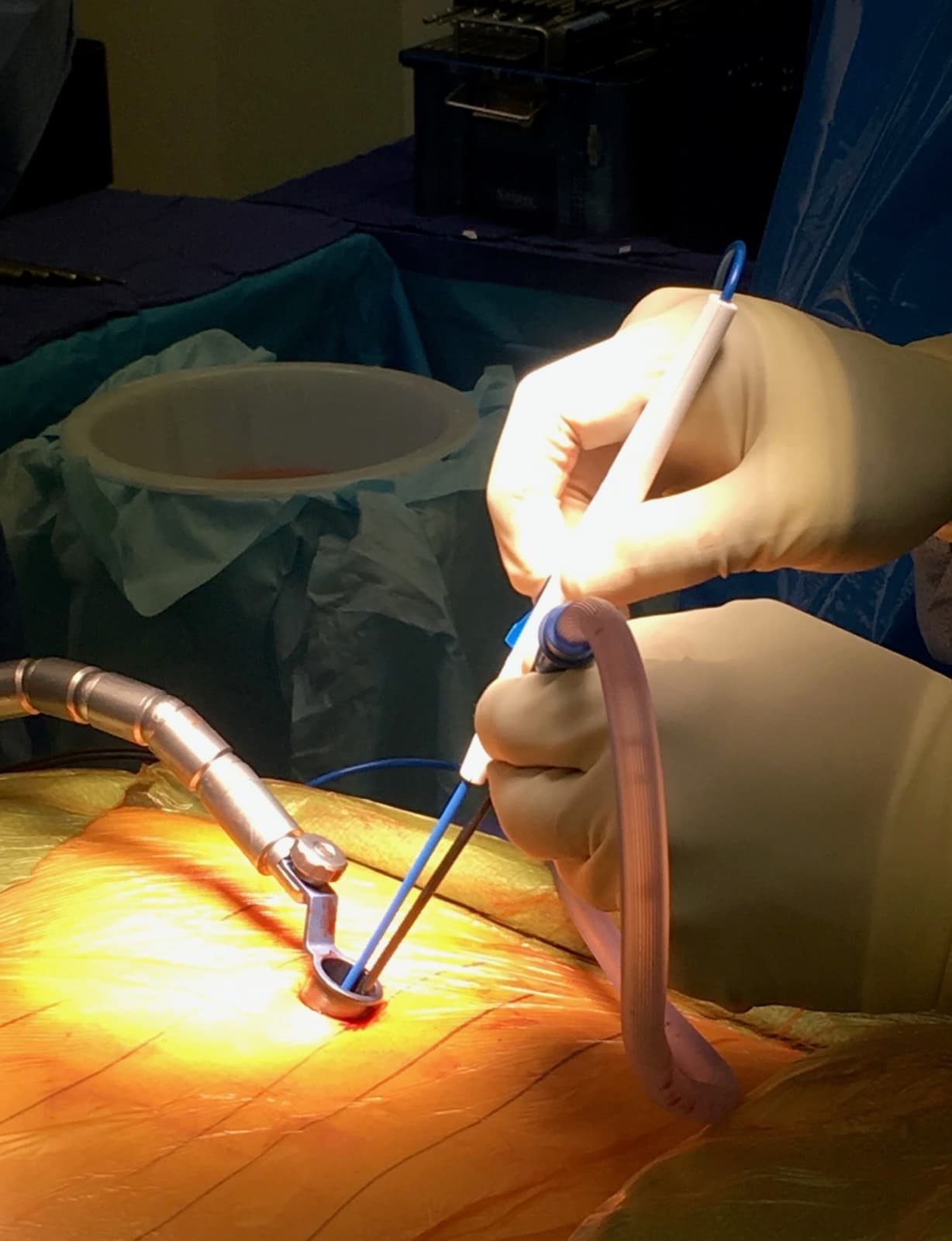
Where surgery is warranted, modern techniques allow many procedures through small incisions, with less tissue disruption and shorter recovery than traditional open surgery. It is not a different operation so much as a different way of reaching the problem, and it is not right for every case — which is a judgment made from the examination and imaging rather than from preference.
Robotic-assisted spine surgery
For procedures requiring implant placement, robotic assistance allows a level of precision that improves accuracy and reduces radiation exposure during the operation. The surgeon still does the operation; the robot is guidance, not autopilot.
Complex spine surgery
Multi-level fusions, deformity correction, and revision surgery — including operating again where someone else’s surgery has not given the result it should have. This is the work Dr. Jimenez’s fellowship training at the Hospital for Special Surgery prepared him for.
Second opinions
Not every finding on an MRI requires an operation, and a scan showing degenerative changes doesn’t necessarily explain the pain you’re having.
If you’ve been told you need spine surgery and want an independent assessment, Dr. Jimenez will review your imaging and examine you, and give you a direct answer about whether he agrees. He performs the same operations, which is what makes his opinion on whether you need one worth having.
Plenty of these conversations end with a non-surgical plan.
“Did the accident cause this, or was it already there?”
This comes up constantly, usually after a scan has found something with a long name on it. It is a fair question and it deserves a straight answer rather than a confident one.
The honest position is that a scan on its own often cannot settle it. Wear-related changes in the spine are visible on imaging in a great many people who have no symptoms at all — which is exactly why the examination matters more than the picture. What an examination adds is whether the thing on the scan explains what you are actually feeling, and that is a more useful question than how long it has been there.
It matters practically, too: the answer changes what treatment makes sense, and it is worth having from someone whose day is spent looking at spines rather than inferred from a report.
If this started with a car accident
The conditions are the same, but the practical situation isn’t — payment works differently, timing matters more, and the documentation of your care becomes relevant beyond the medicine.
Where you’d be seen
Norcross · Lawrenceville · Dalton — Monday – Friday, 9:00 AM – 5:00 PM. All visits are by appointment — please get in touch first.
Dr. Jimenez sees patients in English and Spanish, and no referral is needed.
Telehealth visits are also available where they suit your care. The first conversation with Dr. Jimenez is a phone call.
If you have been looking for a back or neck pain doctor near you, the Norcross and Lawrenceville offices cover Gwinnett County and the northeast side of metro Atlanta, and the Dalton office covers Whitfield County and Northwest Georgia.
Talk it through first
You can speak with Dr. Jimenez by phone within 24 hours before deciding whether to come in.
A free consultation with Dr. Jimenez, within 24 hours — five to ten minutes on the phone, and longer if it needs to be.